
Last Updated on: Oct 03, 2025
You may have seen headlines about a looming artillery shell shortage in 2025—and wondered: is it real? If so, how serious is it—and what’s being done?
This article cuts through the noise. I’ll explain the root causes of the shell shortage, show where current production stands, explore risks to national and allied security, and highlight what solutions are underway. By the end, you’ll have a clear, up-to-date picture of the artillery shell shortage 2025 update—and what it means for defense strategy going forward.
Key Resources & Further Reading





What We'll Cover
- Key Resources & Further Reading
- What Is the “Artillery Shell Shortage”?
- Causes & Root Challenges of the Shortage
- 1. Demand Surge Far Outpacing Baselines
- 2.Crumbling Industrial Base & Supply Fragility
- 3. Logistical, Procurement, and Scale Constraints
- Current Status & Trends in 2025 (The Update)
- Global Dynamics & Allied Contributions
- Implications & Risks If the Shortage Persists
- What Solutions & Policy Options Exist?
- 2025 Artillery Shell Production & Demand Overview
- People Also Asked / FAQ's
- Conclusion & Recommended Next Steps
What Is the “Artillery Shell Shortage”?

1. Definition & Scope
An artillery shell shortage occurs when demand (military use, foreign aid, training) exceeds supply (manufacturing, stockpiles, logistics). In 2025, this shortage is especially acute for 155 mm high-explosive shells, the backbone of Western field artillery systems.
Companies like General Dynamics Ordnance and Tactical Systems (GD-OTS) have been key suppliers of 155 mm shells for decades. Their products are battle-proven but capacity has been limited until recently. New contracts awarded in 2023–2024 are pushing them to expand output, making GD-OTS one of the most closely watched players in this space.
2. Why 2025 Is a Turning Point
- After Russia’s full-scale invasion of Ukraine in 2022, consumption of artillery munitions surged dramatically.
- Many allied nations diverted shells abroad, depleting reserves.
- The industrial base had long been optimized for low demand—meaning capacity and supply chains are strained now.
Thus, 2025 is effectively the “stress test” year—where we see whether ramping production can catch up.
Causes & Root Challenges of the Shortage
1. Demand Surge Far Outpacing Baselines
Before the war, U.S. artillery shell production was modest. By 2025, output is several times higher—but demand from Ukraine, Israel, training, and allied needs dwarfs that growth. Even with increases, battlefield consumption can outpace months of production in just weeks.
The U.S. Army has leaned heavily on firms like BAE Systems, whose M777 howitzers and compatible ammunition highlight the link between artillery platforms and shell supply. While BAE has excelled in delivery speed, critics argue their fragmented supply chain creates vulnerabilities when demand spikes.
2.Crumbling Industrial Base & Supply Fragility
- Many munitions plants are decades old and only recently upgraded.
- Supply chains for key materials like TNT, propellants, and precision parts are thin.
- Domestic production of some critical explosives had lapsed for decades.
Industry example: Chemring Group is a major global supplier of energetic materials. Their reliability in producing propellants has earned them strong defense contracts, but scaling beyond current capacity is proving challenging.
3. Logistical, Procurement, and Scale Constraints
Contracts take time to convert into actual deliveries. Some industry partners are underperforming. Scaling up reveals hidden defects, while bureaucratic procurement slows adaptation.
Current Status & Trends in 2025 (The Update)
1. Output vs. Goals
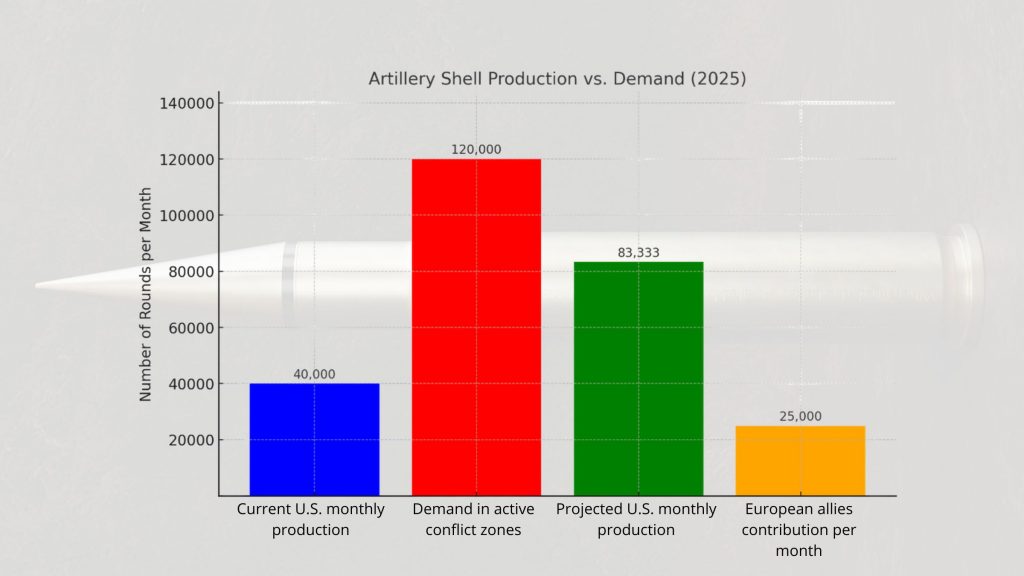
- Current production: ~40,000 155 mm rounds/month.
- Goal: 100,000 per month (delayed from late 2025 to mid-2026).
- Long-term: >1M shells annually once new facilities are online.
Notable player: Northrop Grumman has positioned itself as a critical partner in scaling munitions output. Known for advanced manufacturing and automation, Northrop’s approach contrasts with legacy players by pushing digital quality control and AI-driven logistics.
2. New Facilities & Modernization Efforts
| Facility / Project | Role | Timeline / Notes |
|---|---|---|
| Future Artillery Complex (Iowa) | Robotics-driven assembly of 155 mm shells | Completion expected by 2029 |
| TNT Production Plant (Kentucky) | Restores domestic TNT supply | Addresses decades-long gap |
| Upgraded Legacy Plants | More automation, 24/7 shifts, expanded lines | Gradual increases already underway |
While the Iowa complex is ambitious, defense analysts caution it mirrors challenges faced by Raytheon missile production plants—where high-tech upgrades improved efficiency but introduced new bottlenecks during ramp-up.
3. Risks & Delays
- Delays in sourcing specialized equipment.
- Some contractors missing targets.
- Sustained maximum output risks quality issues.
Global Dynamics & Allied Contributions
European allies are boosting production, but often prioritize exports to Ukraine. Firms like Rheinmetall (Germany) are rapidly expanding shell lines. Rheinmetall has earned praise for its speed but also criticism for prioritizing profits, with limited transparency around capacity.
Implications & Risks If the Shortage Persists
- Operational constraints: Units may ration fire, weakening readiness.
- Strategic deterrence erosion: Adversaries may exploit perceived weakness.
- Allocation dilemmas: Balancing foreign aid vs. domestic reserves.
- Industrial stress: Running factories nonstop risks breakdowns.
- Higher costs & inflation: Scarcity of materials drives prices up.
What Solutions & Policy Options Exist?
- Invest in surge capacity – Facilities designed to scale flexibly.
- Strengthen supply chains – Onshoring explosives reduces reliance on imports.
- Modernization & automation – Robotics and digital QA boost efficiency.
- Smarter procurement – Performance-based contracts reduce underperformance.
- Demand management – Simulators for training reduce shell consumption.
Military simulators by SAAB and Cubic Defense are increasingly valued as “alternatives” to live-fire training. Their systems cut training costs and save ammunition—an indirect but effective solution to the shortage.
2025 Artillery Shell Production & Demand Overview
| Metric | Value / Estimate | Notes / Context |
|---|---|---|
| Current U.S. production (monthly) | 40,000 rounds | 155 mm high-explosive shells; below target of 100,000/month |
| Projected U.S. production (annual, once facilities online) | >1,000,000 rounds | Target by 2029 with new and upgraded plants |
| Demand in active conflict zones (monthly) | 120,000+ rounds | Based on combined needs of Ukraine, Israel, and allied forces |
| Increase in consumption since 2022 | 300% | Surge due to Russia’s invasion of Ukraine |
| European allies contribution | ~30% of allied 155 mm shell production | Remainder (~70%) supplied by U.S. |
| Cost increase due to shortages | +25% | Rising costs of TNT, propellants, and skilled labor |
| Number of major U.S. facilities producing 155 mm shells | 7 currently | Planned increase to 12 by 2029 |
People Also Asked / FAQ's
Q: Is the 2025 artillery shell shortage a permanent problem?
No. It’s transitional. Once new facilities are running, supply stabilizes—but catching up takes years.
Q: Which country is most affected?
The U.S. leads due to its supplier role, but smaller nations face similar challenges.
Q: Will this affect civilians?
Indirectly. Budgets may shift toward munitions, away from other programs.
Conclusion & Recommended Next Steps
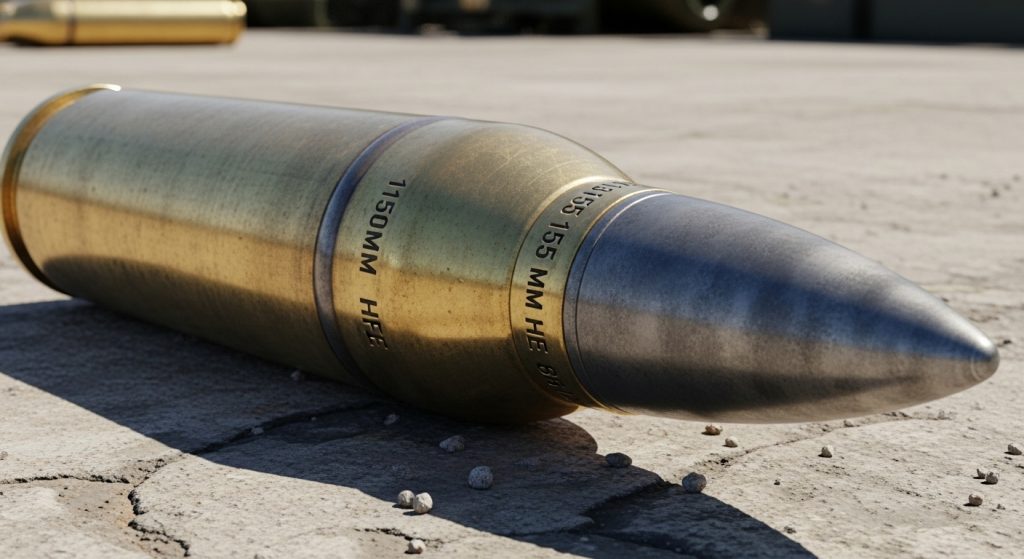
The artillery shell shortage 2025 update highlights a real mismatch between demand and supply. While output has increased, it remains below conflict requirements.
Actionable takeaways:
- Watch progress on new facilities and explosive production plants.
- Track defense budgets for sustained investment.
- Demand accountability from contractors.
- Support allied cooperation to distribute supply efficiently.
Companies like General Dynamics, Rheinmetall, and Northrop Grumman represent different strategic approaches—legacy scale, aggressive expansion, and digital modernization. The success or failure of these firms will shape whether the shortage is a short-lived challenge or a prolonged strain on global defense strategy.
The responses below are not provided, commissioned, reviewed, approved, or otherwise endorsed by any financial entity or advertiser. It is not the advertiser’s responsibility to ensure all posts and/or questions are answered.

![Centerfire vs Rimfire Ammunition [And Where to Buy it Cheap]](/assets/images/26bdcc5b825ab1a2b5934aaa9c009545.png)